1980 Grant Wood American Arts Commemorative Series Gold Coin
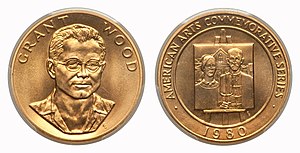
American Arts Commemorative Series Medallions are a series of 10 golden bullion medallions that were produced by the U.s.a. Mint from 1980 to 1984. They were sold to compete with the Southward African Krugerrand and other bullion coins.
The series was proposed by North Carolina Senator Jesse Helms after the United states of america Department of the Treasury began selling portions of the national stockpile of gilt. Iowa Representative Jim Leach suggested that the medallions depict notable American artists. President Jimmy Carter signed the pecker containing the authorizing legislation into police on November 10, 1978, despite objections from Treasury officials.
The medallions were initially sold through mail guild; purchasers were required to obtain the 24-hour interval'southward toll by telephone before ordering. Later, the Mint sold them through telemarketing. Mintage ceased afterwards the ten different medallions approved past Congress were produced. All were struck at the Westward Point Bullion Depository. The series sold poorly, prompting critics to blame the involved procedure by which they were beginning marketed, and the fact that they were medallions rather than coins.
Background [edit]

North Carolina Senator Jesse Helms
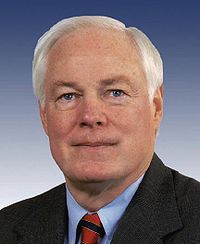
Iowa Representative Jim Leach
On April xix, 1978, the Us Treasury Department appear that a portion of the national gold stockpile was to be auctioned through the General Services Assistants (GSA) beginning on May 23, 1978, in the grade of 400 troy ounces (12 kg) confined.[1] According to the Treasury, the sales were intended to "[reduce] the U.S. trade arrears, either past increasing the exports of gold or by reducing the imports of this commodity",[1] and to "farther the U.Due south. desire to go along progress toward the emptying of the international monetary role of golden".[1] For reasons of accounting, an entire bar was set as the minimum purchase, which placed the gold outside of the reach of nearly Americans.[2] North Carolina senator Jesse Helms was critical of the plan, saying that he was "opposed to the sale of U.S. gold to strange and international banks and golden dealers" and that medallions should be "produced in pocket-sized size, suitable for sale to average citizens".[ii] On the 24-hour interval of the Treasury declaration, Helms introduced the Gilded Medallion Deed of 1978.[3] The stated intent was to provide average consumers with affordable, small-sized gilded bullion to compete with the South African Krugerrand and other world bullion coins, which were becoming increasingly popular with American investors.[three] 1.6 million troy ounces (50,000 kg) ounces of golden had been imported into the U.s.a. in the form of Krugerrands in 1977 solitary.[3] In a hearing on August 25, 1978, before the United States Senate Committee on Banking, Housing, and Urban Affairs, Helms said:
In the beginning yr after enactment the bill would require that the first i.5 million ounces of gold sold exist fabricated into medallions. Nether the stepped-upwards rate of aureate sales, that is only two months worth of gilded. The corporeality is about equal to last yr'southward importation of foreign bullion coins, by and large Krugerrands from Due south Africa.[4]
Helms went on to draw the characteristics of the proposed medallions, stating:
The one-ounce medallion would have on one side the caput of the statue of Freedom atop the Capitol, and information technology would be marked with the words, "One ounce fine gold", and the word "freedom". The opposite of the piece would be the Great Seal of the United states of america and the words "U.s.a.", and the year in which it was produced. The half-ounce medallion would have on one side some representation of the rights of individuals and the words "Human Rights", and "Half ounce fine gilt". The reverse would be like to the back side of the "Freedom" medallion, with the Great Seal.[4]
Support for the medallions grew in Congress, prompting the introduction of more legislation. Iowa representative Jim Leach proposed that the series feature designs honoring American artists. During the Commission on Cyberbanking, Housing and Urban Affairs hearing, Leach outlined the reasons for his proposal. He noted that the Business firm Subcommittee on Celebrated Preservation received many suggestions of individuals worthy to announced on the dollar money that had previously been proposed.[five] [a] Leach felt that a dollar coin was not a suitable way to commemorate the individuals, as it was impossible to accolade such a big group on a coin whose design was likely to remain unchanged for a long period of time.[v] He also noted that all The states coinage until then had depicted individuals whose chief contributions had been in authorities and politics rather than the arts.[5] Leach described the specifics of his proposal, stating:
I am suggesting in H.R. 13567 that nosotros honor 10 individuals who have been distinguished contributors to the arts—music, painting, writing, architecture and the theatre. Other fields might well be called, or other people than I have selected within the field of arts; simply the bespeak I want to emphasize is this: while our coinage is and should be devoted to honoring those who accept contributed to our political heritage, medals offering united states an opportunity to honour those who have contributed to our cultural development, our economic achievements, our technological expertise, and other accomplishments which reflect the wide dimensions of our democratic club.[v]
The subjects designated were painter Grant Wood, contralto vocaliser Marian Anderson, authors Mark Twain and Willa Cather, musician Louis Armstrong, architect Frank Lloyd Wright, poet Robert Frost, sculptor Alexander Calder, actress Helen Hayes and author John Steinbeck.[6]
Though the program received widespread support in Congress, Treasury officials opposed it.[3] In a letter, Treasury secretary W. Michael Blumenthal wrote, "I practise not believe the U.S. Authorities should allow the erroneous impression to be created that it cannot or will non have the necessary steps to combat inflation and that the public therefore needs to purchase gold equally a hedge against aggrandizement."[seven] Blumenthal as well believed that if the regime were to sanction the striking of aureate medallions, the public would believe that the Treasury was actively encouraging investment in golden.[3] Despite these objections, the bill was attached to the bank omnibus bill, which President Jimmy Carter signed into police on November x, 1978.[8]
Production and sale [edit]
The Treasury lacked money to put the medallions into product,[8] so an appropriations nib was passed giving the department the necessary funding.[eight] The GSA was tasked with determining how best to market the new issues.[viii] The GSA proposed several sales plans, including the distribution of the medallions to a network of banks for auction to the public.[eight] This was rejected in favor of requiring purchasers to brand a telephone phone call to learn the toll of the medallions on the day of purchase, after which the purchaser was to get to a postal service office the same mean solar day to brand payment.[8] According to the legislation, the issues were to be "sold to the full general public at a competitive price equal to the free marketplace value of the gilded contained therein plus the cost of manufacture, including labor, materials, dies, use of mechanism, and overhead expenses including marketing costs".[ix]

A half-ounce medallion depicting Willa Cather, in original box of issue
Production began in 1980.[eight] Struck at the West Point Bullion Depository, the medallions contained 90% golden, and were issued in ii sizes: one containing 1 troy ounce (31 1000) of aureate and one containing i half-ounce (16 yard) of the metallic.[ix] The showtime struck were those honoring Grant Wood on the one ounce medallion and Marian Anderson on the one-half-ounce piece.[9] Both were designed by United States Mint Primary Engraver Frank Gasparro.[9] Sales were poor, and in September 1980, the Mint announced that a private firm, article traders J. Aron and Company, would market the medallions.[10] The new plan involved selling the medallions through a network of bullion dealers, banks, brokerage houses and coin dealers,[10] a system similar to that South Africa used to distribute the Krugerrand in the US.[11] In 1981, the second twelvemonth of production, the composition of the medallions was inverse; although the 90% gold purity was retained, the balance was contradistinct to include silverish, which was added to change their appearance.[12] That year'south medallions depicted Mark Twain and Willa Cather. These were designed past Matthew Poloso and Sherl Winter, respectively.[thirteen] These commencement four medallions bore no notation of their metallic content or country of origin. This was done to distinguish them from federal coinage.[9] Commencement in 1982, this information and small-scale, toothlike designs, known as "denticles", were added along the inner rim of the medallions, and reeding was added to the edge.[8] That year's issues depicted Louis Armstrong, as designed by John Mercanti, and Frank Lloyd Wright, designed by Edgar Steever.[13] The following year's medallions depicted Robert Frost and Alexander Calder. The sometime was designed past P. Fowler, while the latter was by Michael Iacocca.[fourteen] The final year of production saw the mintage of medallions with designs past John Mercanti honoring Helen Hayes and John Steinbeck.[xiv] The Mint terminated the contract with J. Aron and Company in 1984,[11] opting instead to sell the medallions through a telemarketing plan.[11] In 1985, Mint director Donna Pope announced that the medallions would be sold in another telemarketing functioning in sets of five of either one each of the one ounce medallions or ane each of the one-half-ounce pieces, beginning in September of that year and ending on December 31, or sooner if all sets sold.[fifteen]
Reception [edit]
In October 1980, Luis Vigdor, assistant vice-president for bullion and numismatic operations of Manfra, Tordella & Brookes, so ane of the largest coin firms in the land, compared the medallions and the efforts to market place them unfavorably to the South African Krugerrand.[16] According to Vigdor, they were difficult to market place due to their lack of note of weight, fineness and country of origin.[xvi] He besides criticized the marketing, asserting that people were unlikely to buy golden at the post office, and that the medallions were advertised poorly. Vigdor contrasted the medallions' marketing programme with the widespread success of the Krugerrand and the vigorous attempts to market them around the world.[16] Commenting on the poor sale of the medallions, assistant director of marketing for the Mint Francis Frere said in 1984: "it just hasn't worked. They're not selling. We've made a strong endeavor, but it's not working."[17]
On February 12, 1982, post-obit the poor sales of the medallions, the United states of america Gold Commission recommended the minting of a aureate coin.[eighteen] Donald Regan, Secretary of the Treasury and chairman of the commission, afterward told reporters that a aureate coin could be easier to sell than medallions, because the suggested coins "could be redeemable in dollars".[xviii] The Mint issued gold coins for the 1984 Summertime Olympics in Los Angeles and for the centennial of the Statue of Liberty in 1986. Both problems were successful, and the Liberty piece sold out on advance sales. As the public was receptive to the gilded coins, and President Ronald Reagan had banned the importation of Krugerrands in 1985 over Due south Africa'south apartheid policy, Congress authorized the American Gold Eagle gilded bullion money, which entered production every bit legal tender in 1986.[19]
Designs and sales figures [edit]
 |  |  |  |  |
| 1980 one ounce medallion, depicting painter Grant Forest | 1980 half-ounce medallion, depicting vocalist Marian Anderson | 1981 ane ounce medallion, depicting author Marker Twain | 1981 one-half-ounce medallion, depicting author Willa Cather | 1982 one ounce medallion, depicting musician Louis Armstrong |
 |  |  |  |  |
| 1982 half-ounce medallion, depicting builder Frank Lloyd Wright | 1983 one ounce medallion, depicting poet Robert Frost | 1983 half-ounce medallion, depicting sculptor Alexander Calder | 1984 one ounce medallion, depicting actress Helen Hayes | 1984 half-ounce medallion, depicting author John Steinbeck |
Notes [edit]
- ^ Social reformer Susan B. Anthony was later chosen to be depicted on a coin known as the Susan B. Anthony dollar.
References [edit]
- ^ a b c U.Due south. Treasury & April nineteen, 1978.
- ^ a b Ganz, p. 69.
- ^ a b c d due east Gilkes, p. 102.
- ^ a b U.S. Senate, p. 3.
- ^ a b c d U.S. Senate, p. 93.
- ^ U.S. Senate, p. 94.
- ^ U.Southward. Senate, p. eight.
- ^ a b c d e f k h Gilkes, p. 103.
- ^ a b c d east Yeoman, p. 405.
- ^ a b U.Due south. Treasury & September 25, 1980.
- ^ a b c Gilkes, p. 201.
- ^ U.S. Mint 1981, p. v.
- ^ a b Yeoman, p. 406.
- ^ a b Yeoman, p. 407.
- ^ U.S. Treasury & September 10, 1985.
- ^ a b c New York Magazine.
- ^ AP & June 26, 1984.
- ^ a b AP & Feb thirteen, 1982.
- ^ Money World Annual 2011, pp. 381, 464–465.
- ^ Coin World Almanac 1990, p. 516.
- ^ Yeoman, pp. 405–407.
Bibliography [edit]
- "Mint Cancels Plan to Sell Medallions". The Fort Scott Tribune. Fort Scott, Kansas. Associated Press. June 26, 1984. p. ten. Retrieved Jan 22, 2011.
- "Panel Urges U.S. Mint Gold Coin". The Lakeland Ledger. Lakeland, Florida. Associated Press. February 13, 1982. p. 7B. Retrieved January 22, 2011.
- Deisher, Beth; Gibbs, William T., eds. (2011). Coin Globe Almanac (eighth ed.). Sidney, Ohio: Amos Press. ISBN978-0-944945-60-5.
- Department of the Treasury (September 10, 1985). "Mint Manager Donna Pope Announces the Sale of Gilt Medallions in 'Sets Only'" (PDF) (Printing release). Archived from the original (PDF) on Oct nine, 2012. Retrieved January sixteen, 2011.
- Section of the Treasury (April xix, 1978). "Sale of Gold by the U.Due south. Treasury (Sale for Dollars)" (PDF) (Press release). Archived from the original (PDF) on October 9, 2012. Retrieved January 16, 2011.
- Section of the Treasury (September 25, 1980). "Sale of Gilded Medallions Extended until December 31" (PDF) (Printing release). Archived from the original (PDF) on Oct ix, 2012. Retrieved January 16, 2011.
- Egan, Jack (October twenty, 1980). "The Bottom Line". New York. 13 (41): 14, 16.
- Ganz, David (Jan 1979). "U.S. Mint Returns to Gilded". COINage. Encino, California: Behn-Miller Publishers: 68–70.
- Gilkes, Paul (August 2010). "Aureate Medallions Launching Pad for Future Bullion Programs". Coin World. Sidney, Ohio: Amos Printing: 102–103, 201.
- Pope, Donna (1981). Almanac Report of the Managing director of the Us Mint (Report). U.S. Government Printing Office. Retrieved February 7, 2015.
- Reed, P. Bradley, ed. (1990). Coin World Almanac (6th ed.). New York, New York: World Almanac. ISBN978-0-88687-460-five.
- United States Senate (1978). Treasury Auction of U.S. Gold and the Gold Medallion Act of 1978. Washington, D.C.: U.Due south. Authorities Press Role.
- Yeoman, R.Due south. (2008). A Guide Volume of United States Coins (62nd ed.). Atlanta, Georgia: Whitman Publishing. ISBN978-0-7948-2491-four.
Source: https://en.wikipedia.org/wiki/American_Arts_Commemorative_Series_medallions
0 Response to "1980 Grant Wood American Arts Commemorative Series Gold Coin"
Post a Comment